Dubai Property Registration Process: A Clear Step-by-Step Guide

Author: Takween Aldar
Date: 04/05/2026
Read time: 15 min
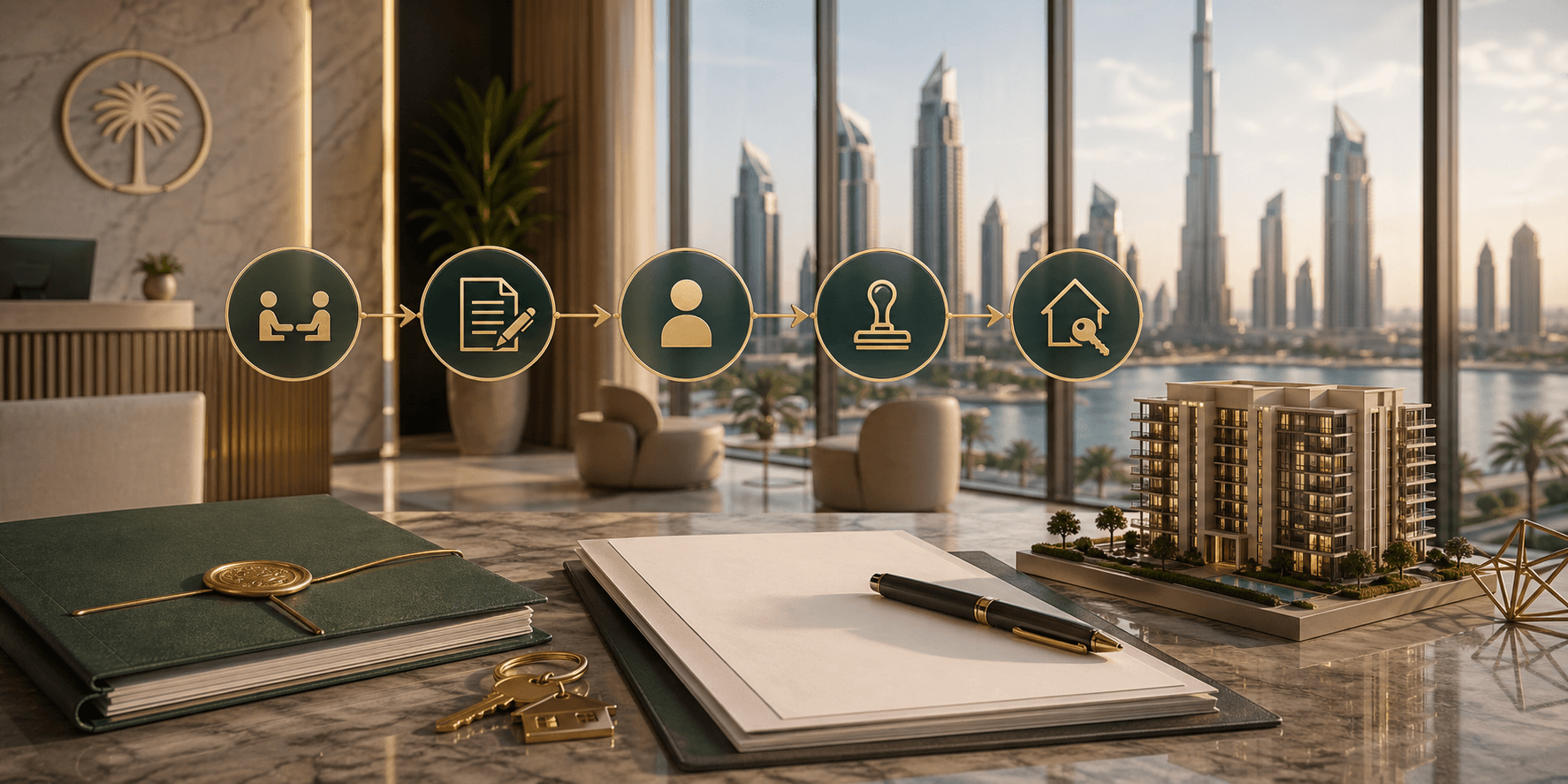
Buying property in Dubai is one of the most exciting financial moves you can make. The city's real estate market is dynamic, globally recognised, and backed by one of the most transparent regulatory systems in the world. But here's what many buyers discover a little too late: buying a property and legally owning a property are two very different things.
The moment that separates the two? Property registration.
Until your name is recorded in the Dubai Land Department's (DLD) official register and a title deed is issued in your name, your ownership has no legal standing. You cannot sell it, mortgage it, lease it, or defend your rights to it in a UAE court. That's not a technicality, it's the law.
So whether you're a first-time buyer, a seasoned investor, or an overseas purchaser navigating Dubai's market from abroad, this guide walks you through the complete property registration process in Dubai step by step, fee by fee, document by document helping you confidently buy property in Dubai.
What Is Property Registration in Dubai and Why Does It Matter?
Property registration is the formal legal process through which the Dubai Land Department records a change of ownership in its official real estate register. The DLD is the government authority responsible for all real estate transactions in the emirate from sales and mortgages to gifts, inheritances, and long-term leases.
Once a transaction is fully registered, the DLD issues a title deed, the definitive proof of ownership recognised by UAE courts, financial institutions, and government authorities.
The title deed contains critical information including:
- The property's exact location and plot number
- Built-up area and floor details
- Full owner details (name, nationality, Emirates ID or passport number)
- Any registered mortgages or encumbrances on the property
- The registered sale value
Without this document, a buyer is merely a party to a private contract not a legally recognised property owner. The DLD's register is what makes ownership real, enforceable, and permanent.
Freehold vs. Leasehold: Know Before You Register
Before diving into the process itself, it's worth understanding one foundational concept that affects who can register what and where.
Freehold Ownership
Freehold gives a buyer complete, indefinite ownership rights over both the property and the land it sits on. In Dubai, freehold ownership is available to UAE nationals, GCC citizens, and foreign nationals but only in designated freehold areas approved by the Dubai Government.
Popular freehold zones include Dubai Marina, Downtown Dubai, Palm Jumeirah, Jumeirah Village Circle, Business Bay, Dubai Hills Estate, and Dubai Creek Harbour, among many others.
Leasehold Ownership
Leasehold gives a buyer the right to occupy or use a property for a specified period typically up to 99 years without owning the underlying land. In non-freehold areas, ownership is generally restricted to UAE and GCC nationals.
Before purchasing, always confirm whether the specific area and development is freehold or leasehold. This directly affects your eligibility to register ownership and the type of title deed you will receive.
Step-by-Step: The Dubai Property Registration Process
The good news? Dubai's property registration process is well-structured, government-regulated, and when you're properly prepared can often be completed in a single day. Here's how it works from start to finish.
Step 1 - Agree on Terms and Sign the MOU (Form F)
The process officially begins when the buyer and seller agree on a purchase price and transaction terms. This agreement is formalised in a Memorandum of Understanding (MOU), also known as Form F - the official sales agreement template in Dubai, regulated by the Real Estate Regulatory Agency (RERA).
The MOU should clearly outline:
- The agreed purchase price
- Payment schedule and method
- Details of the property (unit number, project, community)
- Completion and handover date
- Which party is responsible for which fees (DLD transfer fee, NOC fees, agency commission, etc.)
- Consequences for either party defaulting
Both buyer and seller sign the MOU. In most transactions, a security deposit of around 10% of the purchase price is paid by the buyer at this stage to demonstrate commitment. If the buyer defaults, this deposit is typically forfeited. If the seller defaults, they typically return double the deposit.
Step 2 - Obtain the No Objection Certificate (NOC)
Before ownership can be transferred, the seller must obtain a No Objection Certificate (NOC) from the master developer of the community.
The NOC is the developer's written confirmation that:
- The seller has no outstanding service charges, maintenance fees, or developer dues
- There are no legal or financial disputes relating to the unit
- The developer has no objection to the property being transferred to a new owner
Why this matters: Without a valid NOC, the DLD trustee office will not process the transfer. It protects buyers from unknowingly inheriting the seller's unpaid debts attached to the property.
Key points about the NOC process:
- Processing time typically takes two to five working days, though this varies by developer
- NOC fees range from AED 500 to AED 5,000 plus VAT, depending on the developer
- The NOC is usually the seller's responsibility to obtain and pay for, unless otherwise agreed in the MOU
- NOCs are processed through the Dubai REST App (the DLD's mobile platform) or directly at the developer's offices
- In many communities, the NOC can be issued electronically the DLD accepts e-NOC certificates
Step 3 - Mortgage Pre-Approval and Bank Valuation (If Applicable)
If the buyer is financing the purchase through a mortgage, this stage runs concurrently with (or just ahead of) the NOC process.
The bank will require:
- A property valuation - an independent assessment of the property's market value, typically costing AED 2,500 to AED 3,500, arranged by the lender
- Final mortgage approval - confirmation of the loan amount, interest rate, and repayment terms
- Manager's cheques prepared for the down payment, DLD fees, and bank charges
A manager's cheque (also called a cashier's cheque) is the only accepted payment method at the DLD trustee office. Personal cheques, bank transfers, and cash are not accepted for the main transaction amounts. This is an important practical detail that trips up many first-time buyers to ensure your cheques are prepared correctly and in the right amounts before your appointment.
Step 4 - Visit the Real Estate Registration Trustee Office
This is where ownership officially changes hands. Both the buyer and seller (or their authorised representatives, with a valid Power of Attorney) must attend a DLD-authorised Real Estate Registration Trustee office in person.
The DLD has authorised several trustee offices across Dubai to process property transactions on its behalf. These offices act as intermediaries; they verify documents, process the transaction in the DLD system, collect fees, and issue the title deed.
At the trustee office, the process runs as follows:
- Both parties present their identity documents for verification
- All required documents are submitted and reviewed by the registrar
- Transaction data is entered into the DLD system
- Fees are calculated and paid (manager's cheques are handed over)
- A payment receipt is issued via email
- The DLD auditor reviews and approves the transaction
- A Real Estate Registration Certificate is emailed to both parties
- The new title deed is issued digitally in the buyer's name
For cash purchases, the entire appointment typically takes between one and four hours when all documents are in order. Same-day completion is standard.
For mortgage-backed purchases, additional time is needed for the bank to register its security interest (the mortgage) against the property. This typically adds one to three working days to the timeline.
Step 5 - Pay All Applicable Fees
Fee payment happens during the trustee office appointment. Understanding the full cost structure in advance is essential delays often occur when buyers arrive with incorrect cheque amounts.
Complete Fee Breakdown: What You'll Pay at Registration
DLD Transfer Fee
- 4% of the property's purchase price (or DLD's assessed value, whichever is higher)
- This is the largest government cost and is non-negotiable
- By convention in Dubai, the buyer typically covers the full 4%, though this is technically meant to be split 2%/2% between buyer and seller. Always confirm the agreed split in your MOU.
- For a property valued at AED 2,000,000 this fee alone is AED 80,000
Property Registration Fee (Trustee Office)
- AED 4,200 (AED 4,000 + 5% VAT) for properties valued at AED 500,000 or above
- AED 2,100 (AED 2,000 + 5% VAT) for properties valued below AED 500,000
Title Deed Issuance Fee
- AED 580 for apartments and offices
- AED 430 for land plots
- AED 40 for off-plan contracts (Oqood registration)
Administrative Fees
- AED 250 for villa/apartment map (unified map under Dubai Municipality)
- AED 100 for land map (for plots outside Dubai Municipality's jurisdiction)
- AED 10 Knowledge Fee
- AED 10 Innovation Fee
Mortgage Registration Fee (If Applicable)
- 0.25% of the total loan amount, registered with the DLD
- For a mortgage of AED 1,600,000, this equals AED 4,000
- Plus an additional AED 250 for title deed issuance with mortgage annotation
Agency Commission
- Typically 2% of the purchase price, paid to the real estate agency
- Not a DLD fee, but a standard transaction cost
Developer NOC Fee
- AED 500 to AED 5,000 plus VAT, depending on the developer (usually paid by the seller)
Summary Table: Total Upfront Costs (AED 2,000,000 Property Example)
| Cost Item | Approximate Amount |
|---|---|
| DLD Transfer Fee (4%) | AED 80,000 |
| Property Registration Fee | AED 4,200 |
| Title Deed Issuance | AED 580 |
| Administrative Fees | ~AED 530 |
| Mortgage Registration (0.25%) | AED 4,000 |
| Bank Valuation Fee | ~AED 3,000 |
| Agency Commission (2%) | AED 40,000 |
| Developer NOC Fee | ~AED 2,500 |
| Estimated Total | ~AED 134,810 |
As a general rule of thumb: budget 7-10% above the purchase price to cover all transaction-related costs comfortably.
Documents Required for Property Registration
Arriving at the trustee office with complete documentation is one of the easiest ways to ensure a smooth, same-day registration. Missing a single document can delay the process by days.
For Individual Buyers and Sellers (UAE Residents)
- Original Emirates ID (for identity verification at the trustee office)
- Valid passport copy
- Signed and witnessed MOU (Form F)
- Original title deed (held by the seller)
- Valid NOC e-certificate from the developer
- Manager's cheques for all applicable fees
- Mortgage offer letter / final approval letter (if financing)
- Bank's confirmation of funds release (for mortgage transactions)
For Non-Resident (Overseas) Buyers
- Valid passport (original)
- Certified copy of passport
- Proof of address in home country
- Signed MOU
- Valid NOC
- Manager's cheques (or bank-issued payment instruments)
- Power of Attorney (if a representative is attending on your behalf must be UAE-notarised or attested)
For Corporate (Company) Buyers
- Trade licence
- Memorandum and Articles of Association
- Certificate of Incorporation
- Board Resolution authorising the purchase and identifying the authorised signatory
- Authorised signatory's Emirates ID and passport
- Any additional documents required by the DLD for the specific jurisdiction
Off-Plan Property Registration: The Oqood System
Off-plan properties units purchased during the construction phase before completion follow a slightly different registration process managed through the Oqood system, the DLD's digital platform for interim property registration.
Under Law No. 13 of 2008 Regulating the Interim Property Register, any sale of an off-plan property that is not recorded in the Oqood register is considered legally void. This is one of the most important buyer protections in the market; it prevents developers from selling the same unit to multiple buyers.
How Oqood Registration Works
- Once a buyer signs a Sale and Purchase Agreement (SPA) with the developer, the developer registers the sale on the Oqood portal within a specified timeframe
- The buyer receives an Oqood e-certificate a provisional registration document that records their interest in the property
- This certificate is legally recognised and provides protection throughout the construction period
- The Oqood registration fee is 4% of the purchase price, mirroring the standard DLD transfer fee
- Upon project completion and handover, the Oqood registration is automatically converted into a permanent title deed at no additional registration cost
Additionally, developers are required by law to hold buyer funds in a dedicated escrow account for each project, further protecting buyers if a project is delayed or cancelled.
Common Mistakes That Delay Property Registration
Being aware of these pitfalls in advance can save you significant time and stress:
- Incorrect manager's cheques - cheques made out to the wrong party, in the wrong amount, or incorrectly dated are the single most common cause of same-day delays. Verify every detail before your appointment.
- Expired or invalid NOC - NOCs have a validity window. If registration is delayed after the NOC is issued, it may expire and require renewal (and additional fees).
- Missing Power of Attorney - if either party cannot attend in person, a POA is legally required. UAE-notarised or appropriately attested POAs take time to arrange plan ahead.
- Outstanding service charges - some sellers are unaware of unpaid DEWA bills, community fees, or maintenance charges. These must be cleared before the NOC is issued.
- Property in a dispute or legal hold - if there's an unresolved legal matter linked to the property, the DLD will block the transfer until resolved.
- Incomplete corporate documentation - company buyers often face delays due to missing authorisation letters or expired trade licences.
The Role of Technology: Dubai REST and Digital Title Deeds
Dubai has invested heavily in making the property registration process faster, more transparent, and increasingly digital. Key technology elements include:
- Dubai REST App - the DLD's official mobile application where buyers can verify title deeds, request NOCs, check property status, check trustee office locations, and access a range of real estate services
- Digital Title Deeds - all title deeds are now issued electronically with an official digital seal. They are legally equivalent to paper documents and are accepted by courts, banks, and government bodies
- Blockchain-Based Registry - Dubai has piloted blockchain integration for ownership records, adding an additional layer of security and tamper-resistance to the land register
- e-NOC System - many developers now issue NOCs electronically through the Dubai REST App, reducing processing time and eliminating the need for physical paperwork
These innovations have significantly reduced the time required to complete registration and have made the process more accessible, particularly for overseas investors who can verify ownership status and manage aspects of the process remotely.
How Takween AlDar Guides You Through the Entire Process
Dubai's property registration process is structured and transparent but that doesn't mean it's simple, especially when you're navigating it for the first time, managing it from abroad, or dealing with a mortgaged purchase where multiple stakeholders are involved simultaneously.
This is where the right real estate partner makes an enormous difference.
Takween AlDar is a RERA-certified Dubai real estate agency specialising in helping buyers, investors, and sellers successfully navigate the full spectrum of Dubai's property market. With a team of experienced professionals and over a decade of combined expertise across both international and Dubai-specific markets, Takween AlDar brings the kind of end-to-end support that turns a complex multi-step process into a smooth, managed experience.
Here's how Takween AlDar adds value at each stage of the registration process:
- Pre-purchase guidance - understanding the full cost structure before you commit, so there are no surprises at the transfer table
- MOU preparation and negotiation - ensuring the sale and purchase agreement protects your interests and clearly allocates fees and responsibilities
- NOC coordination - chasing developers, verifying completion timelines, and ensuring the NOC reaches the trustee office within its validity window
- Mortgage liaison - connecting buyers with appropriate mortgage advisors and ensuring the bank's timeline aligns with the transfer appointment
- Trustee office management - preparing the correct manager's cheques, arranging appointments, and accompanying clients through the registration process
- Post-registration support - including DEWA connection, community registration, and investor visa applications where eligible
For overseas investors or a first-time buyer unfamiliar with UAE documentation requirements, having Takween AlDar coordinate the process removes ambiguity and prevents the types of delays that can push a transaction from one week to three.
After Registration: What Comes Next?
Once your title deed is issued, you are the legal owner of the property. Here's a quick checklist of what typically follows:
- DEWA Registration - activate your electricity, water, and cooling accounts (a refundable security deposit of AED 2,000 applies for apartments)
- Community/Homeowner Registration - register with the building or community management for access to facilities and services
- Service Charge Account - set up your annual service charge payment with the jointly owned property management company
- Golden Visa Eligibility - if you've purchased a property with a registered value of AED 2 million or more, you may be eligible for the UAE Golden Visa (10-year renewable residency). The DLD can facilitate this application directly
- Home Insurance - while not legally mandatory, property insurance is strongly advisable and often required by lenders for mortgaged properties
Answers to Your Questions
Frequently Asked Questions

Final Thoughts
Every stage of a Dubai property purchase matters, but registration is the one that makes everything real. It's the moment your contractual rights become legal rights. It's what separates an agreement from ownership.
The process is logical, well-governed, and with the right preparation entirely manageable. Understand the steps, prepare your documents, budget accurately for the full cost (not just the purchase price), and work with professionals who know the system inside out.
Dubai's property market continues to grow in transparency and accessibility. For buyers who approach it with knowledge and the right support, it remains one of the most rewarding real estate markets on the planet.
Insights
Dubai Real Estate Insights
Stay informed with market insights, community guides, buying advice, and investment updates across Dubai real estate. Explore articles designed to help buyers and investors understand pricing trends, area differences, off-plan opportunities, and the practical steps involved in securing property in Dubai.

04/05/2026
Oqood Dubai: Registration Process, Benefits and Costs Explained
Read More
04/05/2026
How to Find Distressed Properties in Dubai: The Complete Investor Guide (2026)
Read More
01/05/2026
Dubai Property Investment Strategies for 2026: Top Tips to Maximize ROI
Read More
28/04/2026
RERA Registration Dubai Guide: Real Estate License Steps
Read More04/05/2026
Oqood Dubai: Registration Process, Benefits and Costs Explained
Read More04/05/2026
How to Find Distressed Properties in Dubai: The Complete Investor Guide (2026)
Read More01/05/2026
Dubai Property Investment Strategies for 2026: Top Tips to Maximize ROI
Read More28/04/2026


 WhatsApp