Freehold vs Leasehold Property Dubai: What's the Key Difference?

Author: Takween Aldar
Date: 04/05/2026
Read time: 13 min
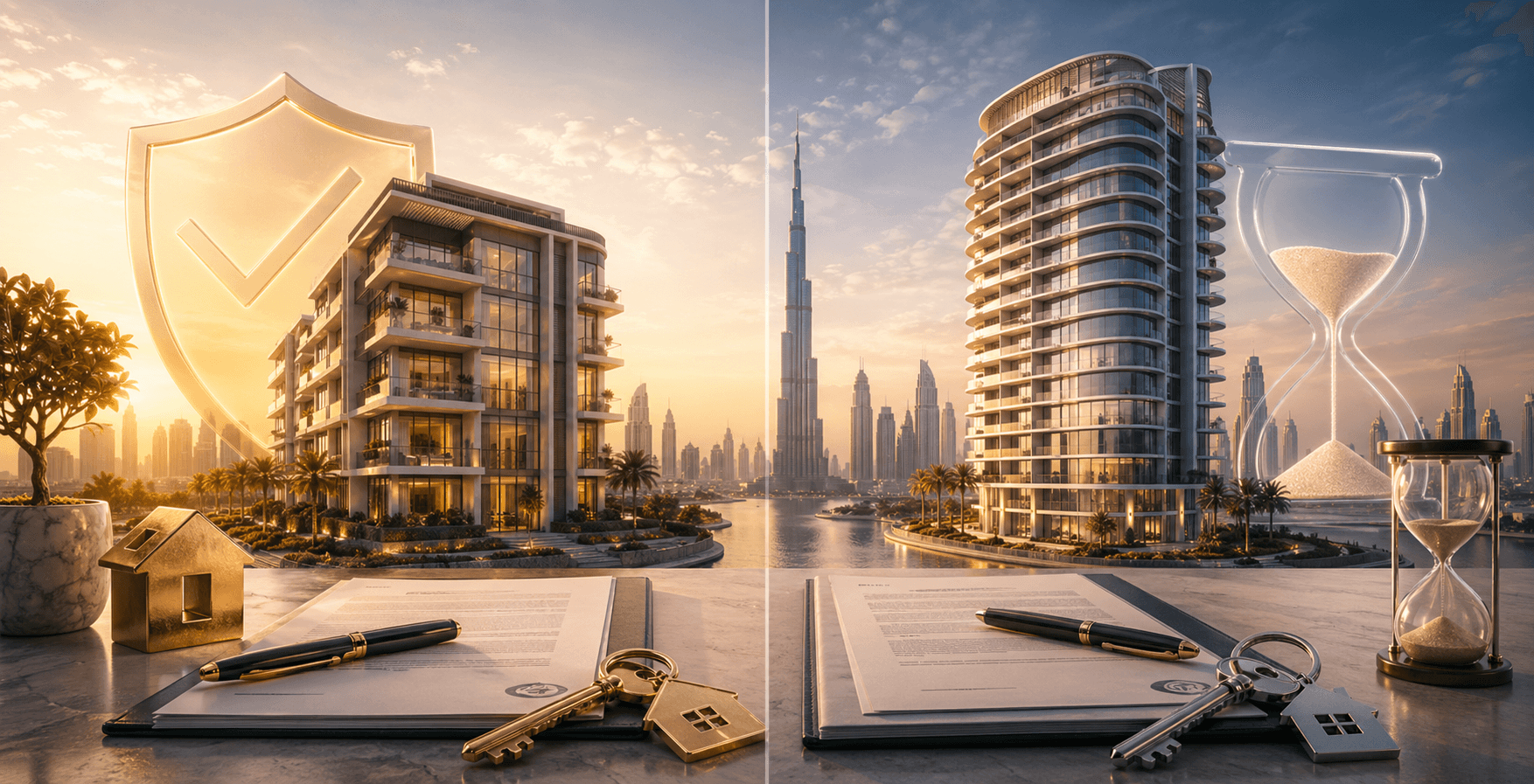
It sounds like a simple question. And in most countries, it barely needs to be asked - you buy a property, you own it, end of story.
But in Dubai, the answer is more nuanced. Here, property comes in two fundamental legal structures: freehold and leasehold. And the difference between the two is not just legal small print, it directly affects what you can do with the property, what it will be worth over time, whether you can pass it to your children, and even whether it qualifies you for a UAE residency visa.
For anyone considering buying property in Dubai in 2026 whether you're a first-time buyer, a seasoned investor, or an expat looking to put down roots, understanding this distinction is not optional. It is the starting point of every property decision you'll make.
This guide breaks it all down clearly, without jargon, and with everything you need to make the right call.
A Brief History: How Freehold Came to Dubai
To understand why freehold and leasehold both exist in Dubai today, it helps to know where they came from.
Historically, foreign nationals in the UAE had no right to own property outright. That changed in 2001, when the Dubai government introduced provisions allowing expatriates to hold 99-year leases on properties in certain designated areas offering long-term occupation rights without full land ownership.
Then, in 2002, the landmark Freehold Decree was issued by Dubai's government, allowing foreign nationals aged 21 and above to purchase, sell, lease, and own property in specially designated areas with full, permanent ownership rights including the land itself. This was a transformational moment. It opened Dubai's property market to global buyers, catalysed a real estate boom, and laid the foundation for the world-class investment market that exists today.
Since then, the list of freehold zones has expanded steadily. As of 2026, there are over 60 designated freehold areas across Dubai. Meanwhile, leasehold arrangements still exist in older and non-designated communities, offering a different kind of ownership for a different kind of buyer.
The legal bedrock of today's ownership framework is Law No. 7 of 2006 Concerning Real Property Registration in the Emirate of Dubai, which formally codified the rights and responsibilities of both freehold and leasehold owners and established the Dubai Land Department (DLD) as the central registry.
What Is Freehold Property in Dubai?
When you buy a freehold property, you own it completely the building, the unit, and the land it sits on with no time limit, no expiry, and no superior landlord above you.
The Dubai Land Department registers your name as the legal owner and issues a Title Deed in your name. From that point forward, the property is yours to do with as you choose, subject only to community rules and building regulations.
What Freehold Ownership Gives You
- Permanent, unlimited ownership - there is no end date on your rights
- Complete freedom to sell - at any time, to anyone, at whatever price the market will bear
- Right to rent or lease the property - short-term, long-term, furnished or unfurnished
- Freedom to renovate and modify - subject to developer guidelines and Dubai Municipality approvals, but without needing a landlord's permission
- Right to pass the property to your heirs - through inheritance or as a gift registered with the DLD
- Eligibility for UAE residency visas - including the 10-year Golden Visa for properties valued at AED 2 million or above
- Full mortgage eligibility - banks in the UAE are comfortable lending against freehold title deeds with standard LTV ratios
Who Can Buy Freehold?
- UAE nationals and GCC citizens - can purchase freehold property across the entire emirate
- Foreign nationals of any nationality - can purchase freehold property in the designated freehold zones only
There is no nationality restriction within freehold zones. Buyers from India, the UK, Russia, China, the USA, or anywhere else in the world are equally eligible to purchase freehold property in Dubai's designated areas.
What Is Leasehold Property in Dubai?
A leasehold property gives the buyer the right to occupy and use a property for a fixed period typically up to 99 years, though 10-year, 30-year, and 50-year terms also exist depending on the arrangement.
The critical distinction: with leasehold, you do not own the land. The land remains the property of the freeholder which is usually a developer, a government entity, or a private landowner. When the lease term expires, ownership of the land and, if not renewed, your rights to the property revert to that freeholder.
What Leasehold Ownership Gives You
- The right to occupy and use the property for the duration of the lease term
- The right to rent out the property to tenants during your lease (though subletting may require the freeholder's approval in some cases)
- The right to sell your remaining lease to another buyer the new buyer simply inherits the remaining term
- DLD registration a 99-year leasehold in Dubai is registered with the DLD and comes with a Leasehold Title Deed, giving it legal standing
- Limited modification rights structural changes or significant renovations generally require written permission from the freeholder
What Leasehold Ownership Does NOT Give You
- Ownership of the land underneath the property
- Guaranteed renewal rights at the end of the term, the freeholder controls the terms of any extension
- Automatic inheritance rights passing a leasehold to heirs is restricted, and at the end of the term the property reverts regardless
- Golden Visa eligibility only freehold property qualifies for the 10-year UAE Golden Visa
- The same long-term capital appreciation profile as freehold as the remaining lease term shortens, the property's resale value typically declines
Freehold vs Leasehold: The Side-by-Side Comparison
| Factor | Freehold | Leasehold |
|---|---|---|
| Ownership of land | ✅ Yes fully owned | ❌ No land stays with freeholder |
| Duration | Permanent no expiry | Fixed term up to 99 years |
| Right to sell | ✅ Anytime, to anyone | ✅ Yes, but buyer inherits remaining term |
| Right to renovate | ✅ Yes (subject to guidelines) | ⚠️ Requires freeholder's written approval |
| Right to sublease | ✅ Unrestricted | ⚠️ May require freeholder's permission |
| Inheritance rights | ✅ Fully heritable | ❌ Reverts to freeholder at end of term |
| Golden Visa eligibility | ✅ Yes (AED 2M+) | ❌ Leasehold not eligible |
| Mortgage accessibility | ✅ Standard LTV applies | ⚠️ More limited depends on term remaining |
| Ground rent | ❌ None | ⚠️ Possible, depending on agreement |
| Entry price | Higher | Generally lower |
| Capital appreciation | Stronger long-term | Can decline as lease term shortens |
| Available to foreigners | In designated zones only | In non-freehold areas |
Key Differences Explored in Depth
1. Land Ownership - The Most Fundamental Difference
This is the heart of the entire debate. In a freehold transaction, you buy the land and everything built on it. In a leasehold transaction, you buy a right to occupy not the land itself.
Why does this matter? Because land is the finite, irreplaceable element that underpins long-term property value. Freehold properties appreciate in part because the land they sit on cannot be replicated. Leasehold properties, particularly as the remaining term shortens, lose that fundamental anchor and with it, resale value, mortgage accessibility, and buyer demand making it a critical consideration when you buy property in Dubai.
2. Capital Appreciation and Resale Value
Freehold properties in Dubai's prime zones have demonstrated exceptional capital appreciation over the past two decades. The city's average residential price per square foot has risen by over 91% since 2020 alone and the overwhelming majority of that growth has been concentrated in freehold communities.
Leasehold properties, particularly those with shorter remaining terms, face a different dynamic. As the lease term reduces, the property becomes harder to mortgage, narrower in its buyer pool, and lower in perceived value. A leasehold with 80 years remaining is a very different asset from one with 20 years remaining.
3. Residency Visa and Golden Visa Eligibility
This is where the distinction becomes critically important for many international buyers.
Dubai offers two property-linked residency pathways:
- 2-year UAE Investor Visa - for freehold properties valued at AED 750,000 or above
- 10-year UAE Golden Visa - for freehold properties valued at AED 2 million or above (renewable, extendable to spouse, children, and dependent family members)
Only freehold properties qualify for these visa programmes. Leasehold properties do not meet the eligibility criteria for either visa pathway, a significant consideration for international buyers who see Dubai property ownership as a route to long-term UAE residency.
4. Inheritance and Generational Wealth
A freehold property in Dubai can be passed on to your children or any designated heir, either through a registered UAE will or through the standard inheritance process. It is a permanent family asset that can build generational wealth.
A leasehold property, by contrast, reverts to the freeholder when the term expires. While it can be sold or bequeathed during the remaining term, no buyer or heir can hold it beyond the lease end date. This limits its value as a long-term family asset.
5. Renovation and Modification Freedom
Freehold owners in Dubai have the freedom to renovate, modify, extend, or redesign their properties subject to community guidelines and any applicable Dubai Municipality approvals. No permission is needed from any superior landlord.
Leasehold owners face a different situation. Any structural change, significant renovation, or modification typically requires written approval from the freeholder. This can slow down projects, add administrative complexity, and in some cases simply be refused.
6. Maintenance Responsibility
This is one area where leasehold can actually offer an advantage. In many leasehold arrangements in Dubai, the freeholder retains responsibility for major structural maintenance and repairs freeing the leaseholder from those costs and obligations. For buyers seeking lower ongoing responsibilities, this can be appealing.
Freehold owners bear the full cost of maintenance themselves, though this is managed in apartment buildings through annual RERA-regulated service charges collected by the jointly owned property management company.
Freehold Areas in Dubai: Where to Buy
As of 2026, there are over 60 designated freehold zones in Dubai, encompassing the vast majority of the city's most popular and actively traded communities. Here are the key areas organised by segment:
Prime Freehold Communities
- Downtown Dubai - Home to the Burj Khalifa and Dubai Mall. The pinnacle of urban luxury living and one of the most globally recognised addresses in the world
- Palm Jumeirah - Dubai's iconic man-made island offering waterfront villas and apartments with direct beach access
- Dubai Marina - A world-class waterfront living community with outstanding connectivity, strong rental yields, and one of Dubai's most vibrant residential environments
- Emirates Hills - Dubai's most exclusive ultra-luxury villa enclave
Premium Mid-Market Freehold Communities
- Business Bay - A dynamic mixed-use district neighbouring Downtown Dubai with strong price appreciation and rental demand
- Dubai Hills Estate - A master-planned family community with parks, schools, and a golf course
- Dubai Creek Harbour - An emerging waterfront masterplan with significant long-term infrastructure investment
- Jumeirah Beach Residence (JBR) - A beachfront community with strong demand from both residents and investors
Accessible Freehold Communities
- Jumeirah Village Circle (JVC) - Dubai's highest-volume transaction community; strong rental yields and good mid-market pricing
- Dubai Silicon Oasis (DSO) - A self-contained technology hub with affordable entry pricing
- Jumeirah Lake Towers (JLT) - Central location along Sheikh Zayed Road with strong tenant demand
- International City - The most affordable entry point in Dubai's freehold market
Worth Noting: The Expanding Map
In early 2025, the Dubai government announced that Al Jaddaf and parts of Sheikh Zayed Road would transition from leasehold to freehold opening these strategic, centrally located areas to full foreign ownership for the first time. This reflects a broader trend: Dubai continues to expand its freehold footprint as part of its long-term strategy to attract global capital and talent.
Block 3 - shared.rich-text - bodyLeasehold Areas in Dubai
While freehold dominates the conversation, leasehold arrangements remain relevant in certain parts of Dubai particularly older, more established communities with strong lifestyle appeal.
Common leasehold communities include:
- Jumeirah 1, 2, and 3 - Traditional coastal neighbourhoods with established villa stock
- Deira and Bur Dubai - Dubai's historic commercial centres
- Al Wasl and Al Barsha (certain zones) - Family-oriented communities with mature infrastructure
- Karama and Mirdif - Established residential areas predominantly restricted to UAE and GCC nationals for freehold ownership
Important: Even within these areas, some individual developments have been granted freehold status. Always verify the specific ownership type of any property directly with the DLD or your agent before making an offer the community-level classification does not always apply uniformly to every building.
Which Is Right for You? Freehold vs Leasehold Decision Framework
Choose Freehold If:
- You want permanent, unconditional ownership with no end date
- You're investing for long-term capital appreciation
- You want to pass the property on to your children or heirs
- You're pursuing a UAE Golden Visa or Investor Visa
- You want full renovation freedom without needing any third-party approval
- You plan to sell the property on the open market with maximum buyer appeal
- You want standard mortgage access with the best LTV terms available
Choose Leasehold If:
- Entry price is your primary constraint and leasehold opens an otherwise inaccessible community
- You want to live in a specific established neighbourhood that isn't designated as freehold
- You're looking for a shorter-term occupancy and don't need long-term capital growth
- You prefer lower maintenance obligations and are comfortable with the freeholder managing the structure
- Visa eligibility is not a priority for you
For the overwhelming majority of international investors and expatriate buyers in Dubai, freehold is the clearer choice for long-term value, security, and flexibility. Leasehold serves a specific purpose and suits specific situations but it should be entered into with a clear exit strategy and realistic understanding of what happens as the term matures.
How Takween AlDar Helps You Choose the Right Ownership Structure
Understanding the theory of freehold and leasehold is one thing. Applying it to a real buying decision where community character, price per square foot, developer reputation, mortgage access, and visa eligibility all need to be weighed together requires a different kind of expertise.
Takween AlDar is a RERA-certified Dubai real estate agency with deep knowledge of both freehold and leasehold communities across the emirate. Their team helps buyers at every stage: from clarifying what ownership type a specific property carries (something that is not always obvious from a listing description) to identifying which freehold communities best align with a buyer's budget, lifestyle preferences, and investment horizon.
Here's where Takween AlDar specifically adds value in the freehold vs leasehold conversation:
- Ownership verification - confirming the exact legal status of a specific unit, not just the community, before a buyer commits
- Community matching - aligning buyers with freehold zones that deliver the right combination of price, yield potential, lifestyle, and long-term growth
- Golden Visa guidance - identifying properties that meet the AED 2 million freehold threshold for Golden Visa eligibility and structuring the purchase accordingly
- Investment strategy - advising on whether a leasehold property in a specific scenario makes financial sense, or whether the access it provides to a certain community is outweighed by the ownership limitations
- Off-plan access - providing early access to new freehold launches in Dubai's most in-demand communities, often before public release and at pre-market pricing
Whether you are purchasing your first property in Dubai or expanding an established portfolio, having clarity on ownership structure before you buy is non-negotiable. Takween AlDar ensures that clarity comes early, not after the contract is signed.
Answers to Your Questions
Frequently Asked Questions

Final Thoughts
In Dubai's property market, what you own matters as much as what you buy. Freehold and leasehold are not just legal technicalities, they are the foundation that determines your rights, your returns, your exit options, and your legacy.
For most buyers who come to Dubai seeking a genuine long-term investment, a home they control completely, visa benefits, and the ability to leave something of lasting value to their family freehold is the clear answer. It is the ownership structure that aligns with Dubai's most powerful investment drivers: perpetual land rights, zero capital gains tax, the Golden Visa, and a property market that has delivered extraordinary long-term growth.
Leasehold has its place for specific communities, specific financial profiles, and specific holding strategies. But it should be entered into with open eyes and a clear plan.
Whatever route you choose, make sure you understand exactly what you're buying before you commit.
Insights
Dubai Real Estate Insights
Stay informed with market insights, community guides, buying advice, and investment updates across Dubai real estate. Explore articles designed to help buyers and investors understand pricing trends, area differences, off-plan opportunities, and the practical steps involved in securing property in Dubai.
04/05/2026
10 Common Mistakes to Avoid When Buying Property in Dubai
Read More
04/05/2026
16 Best Areas for Off Plan Properties in Dubai for 2026
Read More
04/05/2026
How to Buy Property Remotely in Dubai: 2026 Step-by-Step Guide
Read More
04/05/2026
Jumeirah Lake Towers Investment: A Guide to Profitable Property Options
Read More04/05/2026
10 Common Mistakes to Avoid When Buying Property in Dubai
Read More04/05/2026
16 Best Areas for Off Plan Properties in Dubai for 2026
Read More04/05/2026
How to Buy Property Remotely in Dubai: 2026 Step-by-Step Guide
Read More04/05/2026


 WhatsApp