How to Buy Property Remotely in Dubai: 2026 Step-by-Step Guide

Author: Takween Aldar
Date: 27/04/2026
Read time: 14 min
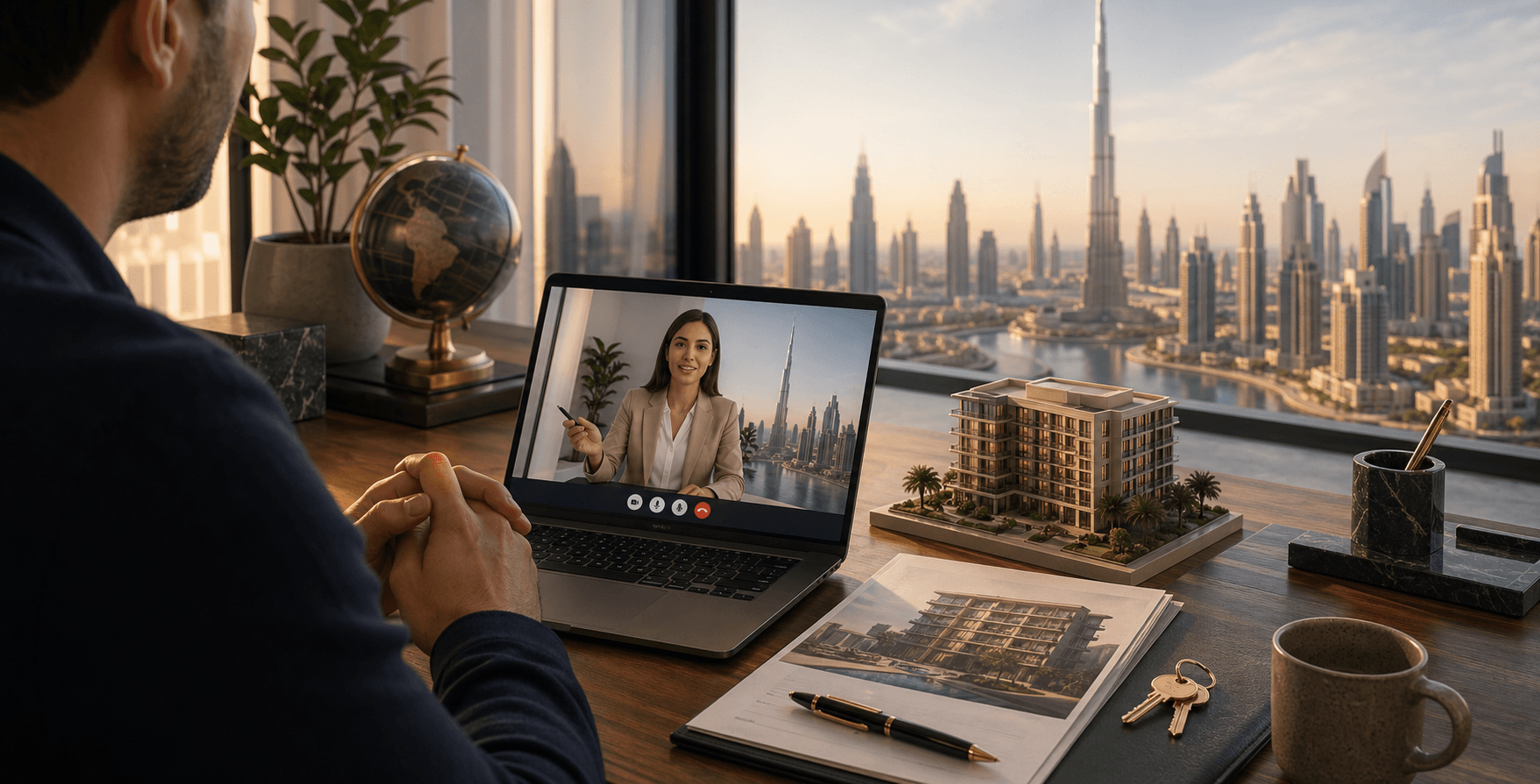
Complete guide to buying property remotely in Dubai, covering legal steps, POA, costs, documents, and how overseas investors can purchase property easily.
How to Buy Property Remotely in Dubai: 2026 Step-by-Step Guide
Imagine owning a property in one of the world's fastest-growing real estate markets tax-free, high-yielding, and backed by a world-class government framework all from the comfort of your home in London, Mumbai, Toronto, or anywhere in the world.
This is not a fantasy. It is exactly what thousands of international buyers are doing every year in Dubai.
The Dubai real estate market recorded over 133,000 property transactions in 2024 alone, with a significant and growing share coming from overseas buyers who never set foot in the UAE during the entire purchasing process. Digital platforms, government-backed transaction systems, and a legally recognised framework for remote ownership have made buying property in Dubai from abroad not just possible but increasingly routine.
Still, "possible" and "easy" are two different things. Without the right knowledge, the wrong step in the process, an improperly attested Power of Attorney, an overlooked fee, or a missed document can cause serious delays or financial loss.
This buyers guide walks you through every step of the remote property buying process in Dubai in 2026, including the latest regulatory updates, documents required, payment methods, and what to watch out for along the way.
Why So Many International Buyers Are Choosing Dubai in 2026
Before diving into the process, it is worth understanding why Dubai continues to attract buyers from over 170 nationalities and why doing so remotely makes strong commercial sense.
The core advantages:
- Zero property tax and zero capital gains tax your returns stay with you
- High rental yields averaging 5-8% annually in well-located communities, significantly higher than most global cities
- Full foreign freehold ownership in designated zones, backed by the Dubai Land Department (DLD)
- Investor visa eligibility a property investment of AED 750,000 or more qualifies for a 2-year residency visa; AED 2 million or more opens the door to the 10-year UAE Golden Visa
- A mature, well-regulated market governed by RERA and the DLD, with strong buyer protections
- Strong population growth driving sustained rental demand
Add to this the speed and accessibility of Dubai's digital real estate infrastructure, and the case for investing remotely becomes compelling.
Is It Legally Possible to Buy Dubai Property Without Visiting?
Yes absolutely, and it is officially supported by the Dubai government. Foreign nationals and non-residents can purchase freehold property in Dubai's designated zones without holding a UAE residency visa and without physically visiting the UAE. The entire transaction from property selection to title deed issuance can be completed remotely through a combination of digital platforms, properly attested legal documents, and a trusted local representative.
The legal backbone of this process is the Power of Attorney (POA), a government-recognised instrument that authorises a designated individual in Dubai to act on your behalf throughout the transaction.
Step 1: Define Your Goals and Budget
Before any document is signed or any viewing is arranged, spend time defining your investment thesis with absolute clarity.
Ask yourself:
- Are you buying to live in Dubai eventually, to rent the property out, or to resell for capital gains?
- What is your realistic total budget including all purchase fees, which typically add 7-10% on top of the property price?
- Are you interested in off-plan (under construction) or ready properties?
- What type of tenant or end-buyer are you targeting, and which communities serve that market best?
- Are you buying in your own name, jointly, or through a corporate structure?
Getting these answers right at the start shapes every decision that follows the area you target, the developer you consider, the unit size you select, and the legal structure you use.
Your budget must account for:
- DLD Transfer Fee: 4% of the property price
- Agent Commission: typically 2% + 5% VAT
- DLD Admin Fee: AED 2,000-4,000 + VAT (depending on property value)
- Title Deed and Map Fees: approximately AED 250
- Legal / Conveyancing Fees: AED 6,000-10,000
- Mortgage Registration (if applicable): 0.25% of loan amount + AED 290
- POA Preparation and Attestation Costs: variable by country
Step 2: Choose the Right Property and Location
Dubai is made up of dozens of distinct communities, each with its own price point, tenant profile, and growth trajectory. Buying in the wrong location simply because it looked good online or was aggressively marketed is one of the most common and costly mistakes remote buyers make.
Key factors to evaluate for any area:
- Rental demand and occupancy rates is there a strong, consistent pool of tenants?
- Supply pipeline: how many units are being delivered in this community over the next 12-24 months?
- Developer reputation particularly important for off-plan; does this developer have a proven track record of on-time delivery?
- Community infrastructure proximity to schools, metro, healthcare, retail, and business districts
- Historical price trends: has the area shown consistent appreciation or volatility?
Tools for remote research:
- DLD transaction data published online
- RERA-regulated portals showing current listing prices and recent sale transactions
- Virtual property tours and detailed developer digital brochures
- Video walkthroughs arranged by your agent via live video call
- Area-specific analytics available on Dubai's REST platform
The right advisory team makes an enormous difference here. Takween AlDar, a trusted Dubai-based real estate consultancy, works extensively with international clients to navigate exactly this stage matching buyer goals with the right areas, developers, and unit types through detailed, data-backed guidance tailored to each client's profile.
Step 3: Appoint a RERA-Certified Agent
Your agent is your eyes, ears, and feet on the ground. For a remote buyer, this relationship is even more critical than it is for someone buying in person.
All real estate agents practising in Dubai must be licensed by RERA and hold a valid Broker Registration Number (BRN). Working with an unlicensed agent exposes you to risk, misinformation, and transactions that may not be enforceable under Dubai law.
What your agent should do for you:
- Conduct thorough market research and shortlist suitable properties
- Arrange virtual viewings via video call or 3D tours
- Verify the property's legal status and confirm it is free of disputes or encumbrances
- Prepare and explain the Memorandum of Understanding (Form F/MOU) in plain language
- Coordinate with the developer, seller, and DLD on your behalf
- Guide you through every document requirement
- Liaise with trustee offices for the final transfer
Always verify your agent's RERA license on the Dubai Land Department's official broker verification platform before engaging them for any transaction.
Step 4: Prepare Your Power of Attorney (POA)
This is the most legally critical step in any remote property purchase. Without a properly prepared and attested Power of Attorney, the transaction cannot proceed at the DLD level.
What Is a POA?
A Power of Attorney is a legal document that grants a designated representative, your agent, a lawyer, or a trusted contact in Dubai the authority to act on your behalf in signing contracts, paying fees, and completing the property registration.
Updated DLD Rules (Circular No. 29/R/2025)
In July 2025, the Dubai Land Department introduced comprehensive reforms to POA requirements. Key changes include:
- The POA must expressly authorise the specific real estate action being taken (purchase, sale, mortgage, etc.)
- The POA must identify the property by title deed or Oqood number vague, general wording will be rejected
- Every POA submitted at a DLD Trustee centre must undergo electronic verification through official government portals before processing QR codes alone are no longer sufficient
- A Property Purchase POA is valid for up to five years under DLD rules
How to Prepare Your POA from Abroad
If you are located outside the UAE, the process is as follows:
- Draft the POA with precise, DLD-compliant wording (engage a legal professional familiar with Dubai property law)
- Notarise the document with a notary public in your home country
- Attest it at the UAE Embassy (or UAE Consulate) in your country
- Legalise it with the UAE Ministry of Foreign Affairs (MOFA) upon arrival in Dubai your representative can handle this on your behalf
- Obtain a certified Arabic translation the DLD requires all documents to be in Arabic or accompanied by a certified Arabic translation
Importantly, per the latest DLD regulations, manager's cheques for the purchase price must be issued in the buyer's (principal's) name not the POA holder's name. This means you will need a UAE bank account.
Step 5: Open a UAE Bank Account
For remote buyers, opening a UAE bank account is a practical necessity rather than just a convenience. DLD regulations require that payments at the point of transfer are made via manager's cheques drawn in the buyer's name. Your POA holder cannot receive or issue cheques on your behalf for the purchase price.
Documents typically required to open a non-resident UAE bank account:
- Valid passport
- Proof of address from your home country (utility bill, bank statement, or government-issued document)
- Bank statements showing source of funds (typically 3-6 months)
- Signed Sales and Purchase Agreement or proof of property ownership (in some cases)
Many UAE banks now offer non-resident account opening services that can be initiated remotely and completed via correspondence or during a brief visit. Your agent or legal advisor can guide you to the appropriate banking channels for your nationality and situation.
Step 6: Sign the MOU and Pay the Initial Deposit
Once you have selected your property and your POA is in place, the next formal step is signing the Memorandum of Understanding known in Dubai as Form F for secondary market (ready) properties.
The MOU is a legally binding agreement between buyer and seller that sets out:
- The agreed purchase price
- Payment terms and schedule
- Responsibilities of each party
- Handover date and conditions
- Agent commission and who bears the cost
- Penalty clauses for default
For ready (resale) properties: A deposit of approximately 10% of the purchase price is typically required at this stage, paid into a trustee account or as a post-dated cheque held by the agent.
For off-plan properties: The reservation deposit (usually 5-10% of the unit price) is paid to the developer, followed by a construction-linked payment plan outlined in the Sales and Purchase Agreement (SPA). Many off-plan developers accept international bank transfers for reservation payments.
Your POA holder can sign the MOU on your behalf if you are not physically present.
Step 7: Obtain the No Objection Certificate (NOC)
For secondary market purchases, the seller must obtain a No Objection Certificate (NOC) from the developer of the building or community before the transfer can proceed. The NOC confirms that there are no outstanding service charges, unpaid fees, or encumbrances on the property.
The process typically takes 3-7 working days and incurs a fee set by the developer, usually ranging from AED 500 to AED 5,000 depending on the project.
Your agent handles this step entirely. As a remote buyer, this is one of the stages where having a proactive, experienced local team is most valuable; delays in obtaining the NOC are one of the most common causes of transaction hold-ups.
Step 8: Complete the Transfer at a DLD Trustee Office
The final and most significant step is the ownership transfer, which takes place at a DLD-approved Trustee Office in Dubai. This is where the title deed is officially registered in your name.
What happens at the Trustee Office:
- Your POA holder attends in your place, presenting the verified Power of Attorney
- Manager's cheques are presented for: the property balance, the 4% DLD transfer fee, admin fees, and any other charges
- The seller (or their representative) confirms the transfer
- The DLD registers the title deed electronically in your name
Once complete, the DLD issues your Title Deed, an electronic document that is the official, government-backed proof of your property ownership in Dubai. A physical copy can be requested if needed.
Timeline for ready properties: From signing the MOU to receiving the title deed, the process typically takes 2-6 weeks for ready properties, depending on document readiness, NOC processing, and bank mortgage timelines (if applicable).
Step 9: Track Your Transaction Digitally
One of the most significant advantages for remote buyers in 2026 is the DLD's digital infrastructure. The Dubai REST app (Real Estate Self Transaction) is the Dubai Land Department's official platform that allows buyers, sellers, and owners to manage property transactions and ownership data entirely online.
What Dubai REST allows you to do remotely:
- Verify your title deed and ownership status in real time
- Track the progress of your application and transfer
- Request an NOC from your developer
- Access service charge records (via the Mollak platform link)
- Monitor mortgage status and registration
- View transaction history for your properties
- Receive real-time notifications on any changes affecting your asset
The platform processed over 320,000 transactions in 2025 and continues to expand its remote capabilities. It is accessible via iOS, Android, and web browser, and is available in both English and Arabic.
Step 10: Arrange Property Management
Once the title deed is in your name, your property needs to be activated as an income-generating asset especially if you are not relocating to Dubai immediately.
What a professional property management service covers:
- Tenant sourcing, screening, and placement
- Tenancy contract preparation and Ejari registration (government rental contract registration)
- Rent collection and transfer to your account
- Maintenance coordination and repairs
- Annual property inspections
- Renewal negotiations and eviction management where necessary
- DEWA (utility) account management
The standard property management fee in Dubai is typically 5-8% of annual rental income. For international buyers, this is not just a convenience, it is the mechanism that converts your title deed into passive income while you remain overseas.
Documents Checklist for Remote Buyers
Keep this list handy throughout the process:
For the POA:
✅ Certified copy of your passport
✅ Notarised POA document in DLD-compliant format
✅ UAE Embassy attestation from your home country
✅ MOFA legalisation (completed in UAE by your representative)
✅ Certified Arabic translation
For the property purchase:
✅ Signed Form F / MOU (or SPA for off-plan)
✅ Proof of funds or mortgage pre-approval
✅ UAE bank account details (for manager's cheques)
✅ Seller's original title deed (confirmed by your agent)
✅ Developer's NOC (for secondary market properties)
✅ Manager's cheques in buyer's name for all fees
Why the Right Advisory Partner Changes Everything
Remote property or apartments buying in Dubai is entirely achievable but the complexity of POA preparation, document attestation, regulatory compliance, DLD coordination, and payment logistics means the quality of your advisory team has a direct impact on how smooth, fast, and risk-free the transaction will be.
Takween AlDar a Dubai real estate consultancy specialises in guiding international buyers through every stage of the remote purchase process. Their multilingual team has deep expertise in Dubai's regulatory landscape, off-plan and secondary market dynamics, and the cross-border documentation requirements that often catch buyers off guard.
From the initial strategy call to post-handover property management, Takween AlDar provides a structured, transparent service that removes the guesswork from buying across borders. For international investors who want to move confidently in one of the world's most exciting property markets, having a knowledgeable local team is not a luxury, it is a necessity.
Answers to Your Questions
Frequently Asked Questions
Final Thoughts
Dubai has done something remarkable: it has built a real estate market so transparent, so well-regulated, and so digitally accessible that buyers from across the globe can now invest safely without ever leaving their homes. The technology is there. The legal framework is there. The returns are there.
What remains is execution and execution requires preparation, the right documents, the right advisors, and a clear understanding of each step in the process.
Whether you are a first-time buyer or an experienced investor expanding your portfolio, use this guide as your roadmap. Take each step carefully, work with professionals you trust, and you will find that buying property in Dubai from abroad is not only possible in 2026 it is one of the smartest financial moves you can make.
NEWS & INSIGHTS
Strategies Your Current Agent
Won't Tell You
Loading...


 WhatsApp